
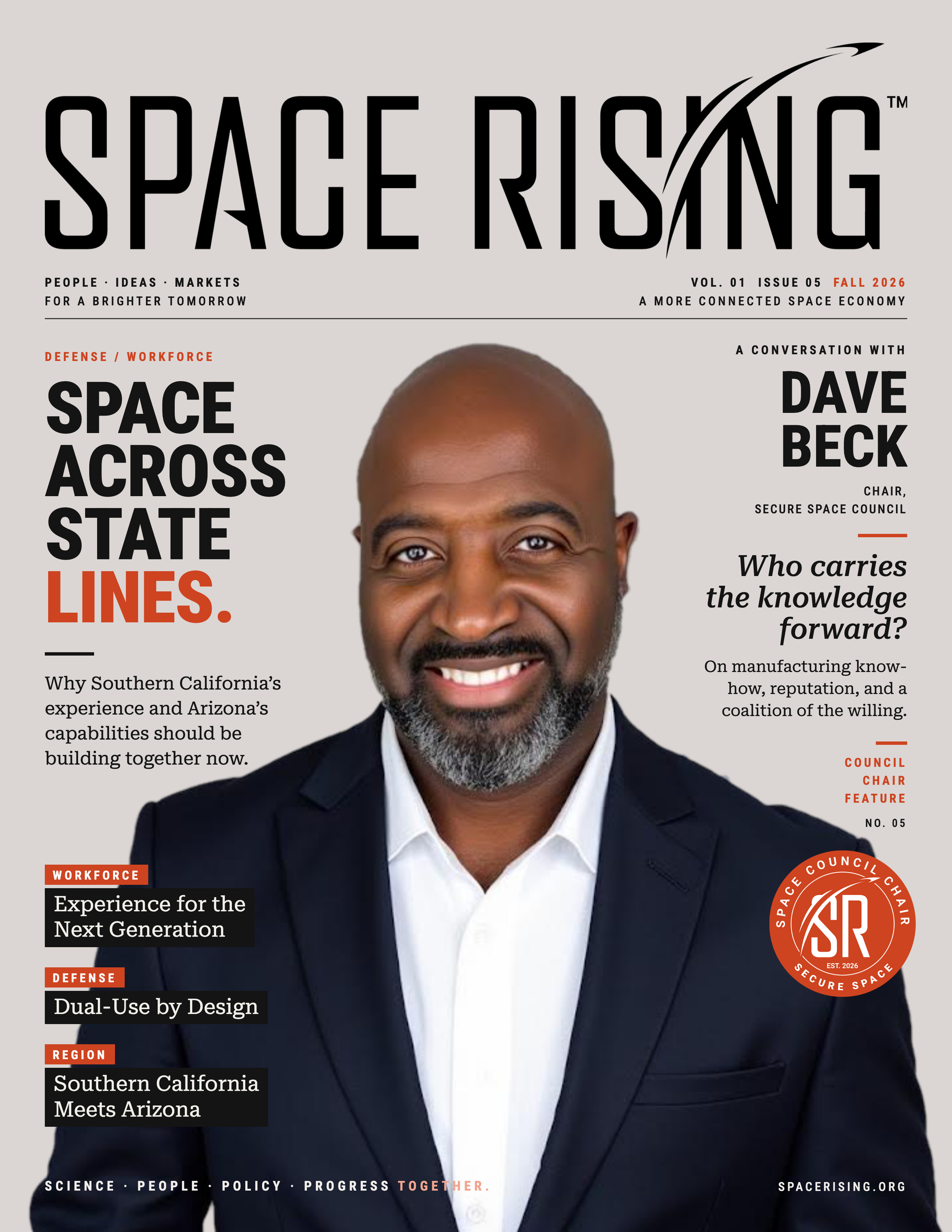
DEFENSE / WORKFORCE / REGIONAL COLLABORATION
Space Rising’s Secure Space Council Chair sees an opportunity to connect Southern California’s experience with Arizona’s capabilities, while making sure the knowledge needed to build the next generation of space systems reaches the people who will use it.
By Angelica Sirotin | Oct 9, 2026 | Space Rising
Dave Beck is thinking about the people who know how to build things.
In Southern California, he sees experienced engineers, manufacturing specialists, and tool-and-die workers whose knowledge could help a new generation of space companies. He also sees a reason to act soon.
“That knowledge is getting seasoned,” he says. “And that knowledge might not be around forever.”
For Beck, developing the space economy means making better use of that experience: connecting it to younger teams, giving capable people opportunities to contribute, and building relationships across regions that have something to offer one another.
As Chair of Space Rising’s Secure Space Council, he brings a career spanning military service, manufacturing, autonomous systems, and government. His Space Rising profile identifies him as Principal of Space Technologies LTD, with work focused on industrial capabilities and technologies serving commercial and defense needs.
His vision reaches across state lines. He wants Southern California and Arizona to understand more clearly what they could build together.
Learning how the pieces connect
Beck’s interest in space began with Star Wars and Star Trek while growing up in the South. Turning that interest into a career took him through the industries and institutions that make complex technology possible.
After college and five years of combined active and reserve service in the Marine Corps, he pursued hands-on engineering work. His experience included chemical processing, automotive manufacturing, aircraft engines, and fuselages.
Later, work in autonomous vehicles brought him into computer systems, operating architectures, and the relationship between technology and dependable transportation.
Government added another perspective. Beck wanted to understand how agencies evaluate technology, approach regulation, and consider its implications for the public. His experience extended across transportation and defense, including service as a U.S. Space Force branch chief, a role documented in NordSpace’s 2025 conference program.
Together, those experiences shaped how he sees the space sector.
“You look at space like an umbrella,” he says. “Everything’s connected under the umbrella.”
A technology’s prospects depend on the surrounding capabilities: the people who can manufacture it, the systems needed to operate it, and the organizations prepared to support its use.
The influence closest to home
Asked who helped him find his direction, Beck names his uncle.
“He was the first in our family to go in the Marine Corps.”
His uncle also had a science background and worked in water purification in Los Angeles. Through him, Beck began to understand the engineering involved in something as fundamental as access to water.
That early exposure helped connect scientific curiosity to practical responsibility. Water, infrastructure, and the systems people depend on became subjects he could see and understand through someone else’s work.
Beck credits that mentorship with helping shape his own development as a systems engineer. The relationship remains important enough that he chose to live nearby so he could be available to support his family.
His concern about passing knowledge to the next generation has a personal foundation. He knows what it meant to have someone make an unfamiliar field accessible.
Recognizing the work people can do
When the conversation turns to obstacles, Beck raises the weight placed on academic pedigree.
He believes the space industry has an opportunity to give greater consideration to a person’s accumulated work: what they have built, the problems they have solved, and the judgment they have developed.
He recalls a recent conversation in which a venture-capital contact praised his experience while suggesting that his academic background could reduce his chances of being selected for an opportunity. For Beck, it illustrated how easily useful experience can be discounted.
His response is to keep building a record that people can evaluate.
“Your reputation is all you have,” he says. “And you have to build it.”
“It takes a lot of years and work to build that, but it only takes a few seconds for it to fall down.”
That emphasis on demonstrated contribution also informs his view of workforce development. An industry seeking more capable people needs ways to recognize the experience already available to it.
Carrying experience into the next generation
Beck wants Southern California to build on the depth of expertise associated with its aerospace history, including the Space Shuttle program.
“There’s a lot of talent here,” he says. “There’s a lot of hard work ethic.”
He would like to see stronger collaboration among the state, industry, and workforce organizations to help that experience reach emerging companies and younger workers. He is particularly concerned about manufacturing knowledge that could leave the industry as experienced people retire.
His current work also extends into Canada. Beck describes helping NordSpace develop relationships and opportunities in the U.S. market, building on connections established during his government career.
The conversation took place shortly after NordSpace’s Terra Nova satellite launched on Oct 1, 2026 aboard SpaceX’s Transporter-18 mission. On Oct 5, 2026, the company reported successful early operations in orbit.
Beck spoke about what such milestones mean to the engineers who make them possible. He sees the relationships among the United States, Canada, and Mexico as deeply interconnected, with opportunities to strengthen the wider space community through collaboration.
Connecting Southern California and Arizona
For Beck, the regional opportunity is already personal. He has family in Phoenix and has spent parts of his career working with companies in the Phoenix and Tucson areas.
He sees capabilities on both sides of the state line that could complement one another.
“I would love to see a coalition of the willing here in Southern California with the state of Arizona,” he says.
His interest is in identifying where organizations can contribute to a shared effort, including technologies with both commercial and defense applications. Better communication is central to that work. Companies and institutions need to understand what others can do, what they need, and where cooperation would be useful.
For Space Rising’s Secure Space Council, his perspective suggests several practical starting points:
Connect organizations around a defined need.
Identify a specific engineering, manufacturing, or operational requirement, then explore which capabilities in Arizona and Southern California could help address it.
Give experienced practitioners a role in developing new talent.
Explore ways for established engineers and manufacturing specialists to work with emerging teams on real problems, making their judgment and experience accessible.
Turn an introduction into a concrete next step.
A potential collaboration becomes easier to assess when participants can identify the work, their respective contributions, and the questions that still need answers.
These are opportunities to explore through the council’s work. Beck’s larger ambition is to make it easier for people with complementary experience to recognize one another and begin building.
“Let’s put everybody on a particular path and build something special,” he says.
For Arizona and Southern California, that path could begin with a better understanding of the people and capabilities already within reach.
Have a story the space community should hear?
We’d love to hear what you’re working on. Talk to us about a sponsored feature in Space Rising, with an interview-led article and a custom magazine cover your team can share.
Get in touch: angelica@spacerising.org
Dave Beck | Principal, Space Technologies LTD | Secure Space Council
This interview was conducted by Space Rising. Quotes have been lightly edited for length and clarity.
