
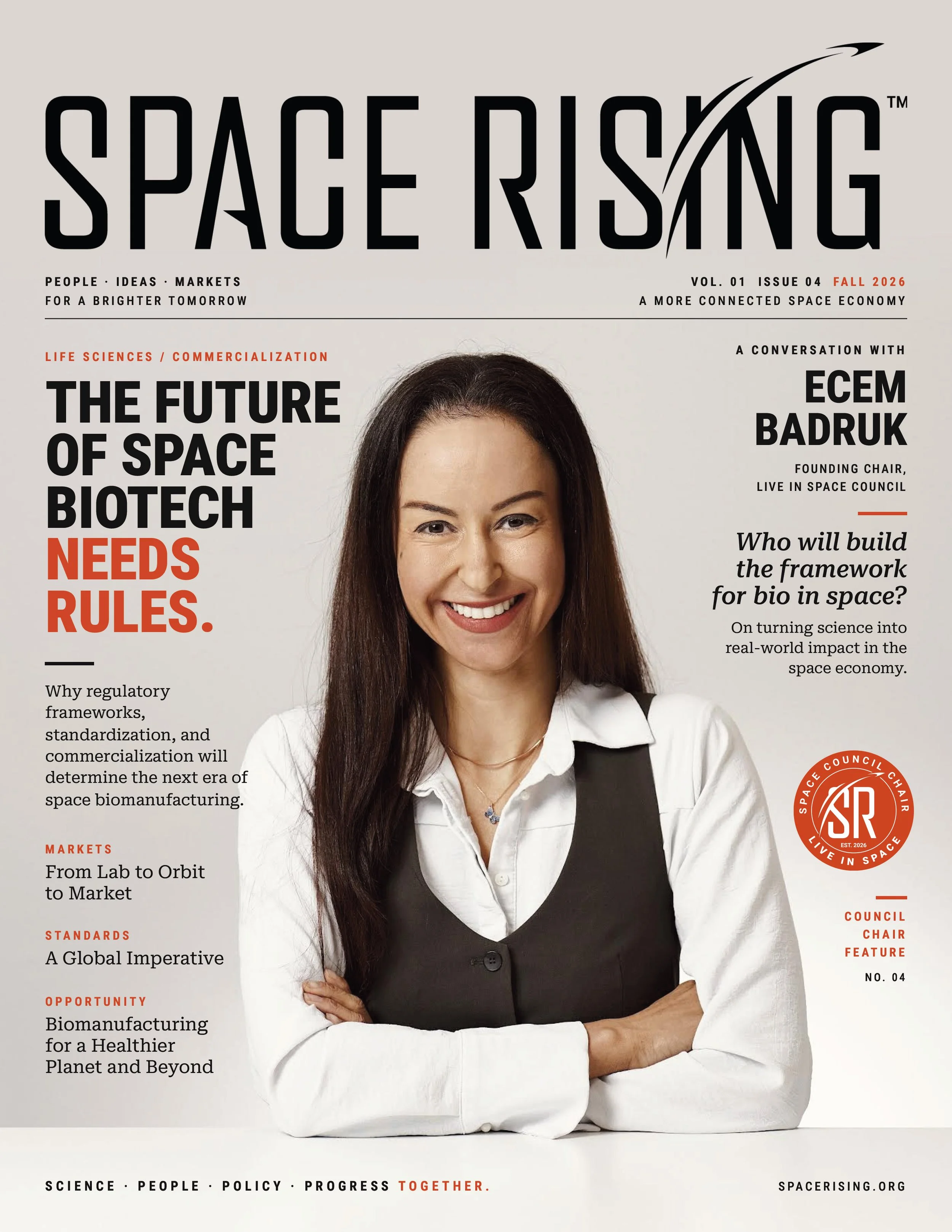
Ecem Badruk, Founding Chair of Space Rising’s Live in Space Council, on Bringing Space Biotech to Earth
Ecem Badruk, Founding Chair of Space Rising’s Live in Space Council, on Bringing Space Biotech to EarthEcem Badruk | Founder, Business Developer | Connect with Ecem
LIFE SCIENCES / COMMERCIALIZATION
Ecem Badruk wants more biotech and pharmaceutical companies involved in space-based research. For Arizona, her work raises a practical question: what would give them a reason to participate?
By Angelica Sirotin | Sept 30, 2026 | Space Rising
Ecem Badruk was already a bioengineer when her nephew’s fascination with planets made her look more closely at space. A couple of months later, a project involving bioprinting in space came her way. She began researching what was happening beyond Earth in her own field.
She found work involving drug development and biological experiments she had never seriously considered. “I’m a bioengineer, and I’d never thought about [space biotech] before,” she recalls. The more she read, the more she wanted to be part of it. “And then I said, ‘I’m gonna do this.’”
Badruk now joins Space Rising’s Live in Space Council as its Founding Chair. A bioengineer specializing in tissue engineering and regenerative medicine, she brings business development experience across biotech and deep technology. She is also the founder of Women in Space Biotech, an initiative supporting visibility, collaboration and leadership in the space life sciences community.
As she explored the field, she came across Jana Stoudemire’s work. Stoudemire became an important source of inspiration and someone with whom she could discuss space biotechnology and possible ways to work together. Her nephew still prefers the planets, she noted. The interest they share has taken her into subjects he is not quite ready to discuss.
Her own introduction to space biotechnology helps explain the audience she is trying to reach today. She had relevant scientific training before she understood the possibilities. She suspects there are many more people in biotech and pharmaceuticals who could contribute, once they can see how the work connects to their own.
The business conversation is harder
Asked what has been difficult, Badruk separates the engineering challenges from the business of getting people involved. She has confidence in the researchers and engineers working through the technical problems. “We have challenges, yes, but we are trying to find a way.”
The business side has been harder. In conversations with biotechnology and pharmaceutical professionals, she often encounters limited familiarity with space-based research. She sees that lack of awareness restricting participation. More people working in the field would, in her view, mean more experiments and a stronger body of results to examine.
She revisits the word “convincing.” What she wants is to show prospective collaborators the research and explain its relevance to projects they already understand. She believes some findings make a compelling case for further work. Getting those findings in front of the right people has become part of her job.
That is why she takes part in pharmaceutical and biotech conferences and webinars. She wants the conversation to reach people in their own professional settings, where they can consider what a space-based experiment might mean for a problem they are already trying to solve.
“We are not talking in the same language.”
Badruk is describing the difficulty of working across aerospace engineering, bioengineering and molecular biology. Each discipline brings its own vocabulary. Space professionals may not understand what a biotech company needs; biotech professionals may be equally unfamiliar with the space sector. “We need more people to talk to both sides,” she says.
Biological products made in space, used on Earth
Her longer-term ambition is to build a scientific and entrepreneurial community capable of manufacturing biological products in space and bringing them back to Earth. Asked about five to ten years, she considers five optimistic. Ten is the horizon she is working toward, although the conversation is about her ambition rather than a product delivery schedule.
She points to microgravity as an unusual experimental environment and to the different cellular behavior researchers can investigate there. “We are going to have biological products which are made in space,” she says. The outcome she pictures is a product label: “made in space” alongside “made in Germany” or “made in USA.”
The patient remains central to that vision. Someone taking a medicine is generally concerned with getting better, she says, rather than the country where it was made. She applies the same reasoning to a future product manufactured in space. Its relevance would come from what it could do for the person who needs it.
What this could mean for Arizona
Arizona has places to begin the conversation. ASU’s Biodesign Institute has documented research involving microgravity and three-dimensional tissue models. AZBio brings together businesses, researchers and health care organizations across the state’s life sciences sector. Badruk’s interview suggests a way to connect that work with the space economy through specific research needs and possible projects.
For the Live in Space Council, the following are practical starting points to explore with Arizona’s companies and researchers.
Begin with a biomedical problem
Invite life sciences teams to bring a question from work already underway. A tissue-engineering group or a drug-development team could describe what its current methods cannot yet answer. A space research specialist could then help assess whether microgravity offers a relevant way to investigate it. The first discussion should establish what evidence would make further work worthwhile.
Make introductions around a defined need
Use those questions to identify prospective collaborators. Depending on the project, that might mean introducing a researcher to a payload developer, an automation company or a laboratory able to analyze returned samples. Ask each participant what it can contribute and what it still needs. AZBio’s network and university research groups could provide places to begin outreach; their involvement would need to be discussed.
Give the first project a manageable scope
A useful early outcome could be a short feasibility brief for one proposed experiment. Identify the Earth-based comparison and the result the team hopes to measure. Establish which facilities or flight services would be needed, with preliminary costs and responsibilities for follow-up. That would give prospective partners something concrete to evaluate before making a larger commitment.
Bring specific decisions to Space Congress
Ahead of Space Congress on April 20, 2027, in Phoenix, the council could gather candidate projects and the questions preventing them from progressing. Participants could then identify which collaborations merit follow-up and which gaps belong in the Arizona Space Blueprint. A practical measure of progress would be whether a team leaves with an agreed next step and a person responsible for it.
For Badruk, a project made the connection between her training and space tangible. Arizona’s researchers and companies could find their own entry points in much the same way, through a question worth investigating and someone prepared to work on it with them.
Have a story the space community should hear?
We’d love to hear what you’re working on. Talk to us about a sponsored feature in Space Rising, with an interview-led article and a custom magazine cover your team can share.
Get in touch: angelica@spacerising.org
Ecem Badruk | Founder, Business Developer | Connect with Ecem
This interview was conducted by Space Rising. Quotes have been lightly edited for length and clarity.